Bottlenecks in trail running: how to position yourself at the start so you don't get stuck
Bottlenecks: the silent enemy of your race
You’ve trained for months. Your nutrition plan is ready, your gear checked, your shoes broken in with 50 km. The gun goes off and 500 runners start at once. At 800 metres, the wide track narrows into a half-metre singletrack. And that’s the end of your race as you had planned it.
Bottlenecks — those choke points where dozens or hundreds of runners squeeze into a narrow passage — are one of the most frustrating experiences in trail running. And the worst part: most of them can be avoided with a good positioning strategy.
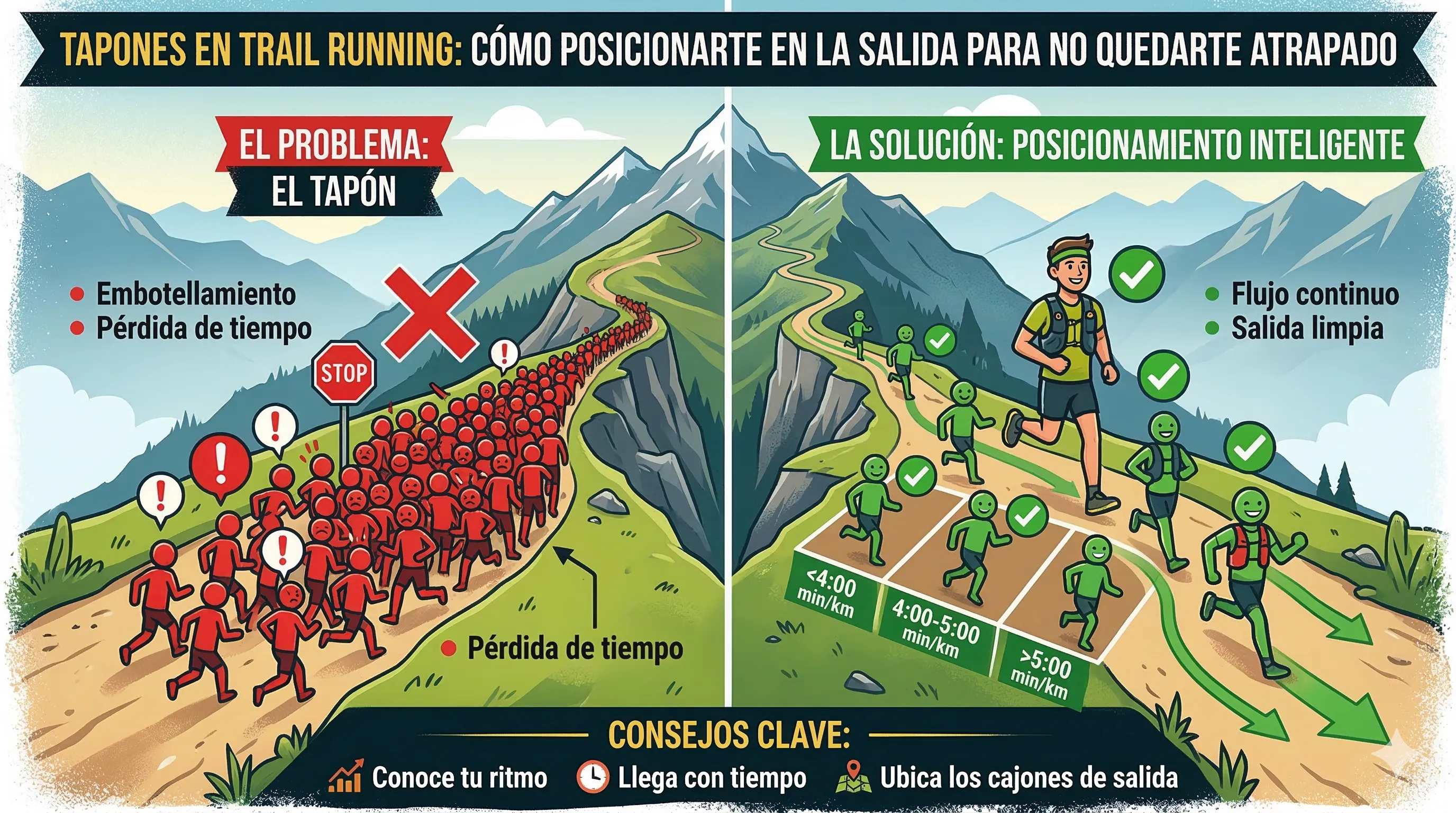
Why bottlenecks cost you more than you think
A bottleneck isn’t just losing 2 or 3 minutes waiting. The real impact is bigger:
- Accumulated lost time: a 3-minute bottleneck at 800 m can turn into 5-8 minutes by the finish, because it breaks your rhythm just when you should be settling in.
- Frustration heart rate: standing still or forced to walk while your body is in “race” mode creates stress and unnecessary heart rate spikes.
- Broken rhythm: the first 2-3 km are key to finding your cruising pace. A bottleneck forces you to brake and then accelerate to recover, burning extra energy.
- Injury risk: trodden heels, elbows and stumbles are common when 50 people try to move through a space meant for 2.
- Cascade effect: if you lose places in the first bottleneck, you’ll reach the second (if there is one) with even more people around you.
Study the start before you step into the corral
This is the difference between a runner who suffers bottlenecks and one who avoids them: knowing the first 2-3 km of the course. You don’t need to memorise the whole route, but you do need to know this:
What to look for before the race
- Where does the path narrow? Identify the exact point where the wide track becomes singletrack. That’s the main choke point.
- How far from the start? If the singletrack starts at 500 m, you need to position yourself very well. If it’s at 3 km, you have more margin.
- What’s the first tight bend? Bends compress the pack. If it turns right, the inside of the bend is the right. If it turns left, the inside is the left. The inside is where you want to be.
- Is there an immediate climb? If the singletrack starts uphill, the bottleneck is worse because speed drops drastically. On the flat or downhill, the group strings out faster.
- Any early obstacles? Gates, river crossings, rock steps… anything that forces runners into single file.
How to get this information
- The organiser’s GPX track: load it onto your GPS watch and view the first kilometres on the map. Identify where the path narrows.
- Videos of previous editions: YouTube is your best ally. Look up the start of past editions and you’ll see exactly where the bottleneck forms.
- On-site recce: if you can, walk or jog the first 2 km the day before. Nothing replaces seeing the terrain with your own eyes.
- Technical briefing: many organisers explain the particulars of the start. Don’t skip it.
Where to stand in the start corral
The start corral is like a chessboard: your position determines your first moves. There are two axes: front-back and right-left.
Front-back axis: be honest about your level
| Your level | Where to stand | Why |
|---|---|---|
| Top 10% | First 2-3 rows | You’ll reach the narrowing before the bottleneck forms |
| Top quarter | Rows 4-8 | Enough to enter the singletrack smoothly |
| Middle of the pack | Middle area | Assume there will be a bottleneck; don’t get frustrated trying to move up |
| Back third | At the back, no rush | The bottleneck will have partly cleared by the time you arrive |
The most common mistake: standing too far forward. If you start in the front row but your pace is mid-pack, you’ll be a bottleneck for everyone else and get passed by dozens of runners in the first 500 metres. That’s more stressful than waiting in a bottleneck.
The golden rule: stand where you think you’ll be at 5 km. If your pace puts you 150th out of 500, don’t start from 20th.
Right-left axis: the cornering tactic
This is where the real gains are. Almost nobody thinks about it, but it’s the most profitable decision you can make at the start:
- If the first bend turns right → stand on the right side of the corral. You’ll take the inside of the bend, cutting distance and avoiding being squeezed to the outside by the pack.
- If the first bend turns left → stand on the left side of the corral.
- If the path runs straight to the singletrack → stand on the side where the singletrack opens. If it leaves from the right of the wide track, go right.
The “second inside” trick
If you can’t get to the front row but you can get to the right side, you’re in a good position. When the pack compresses in the bend, those on the outside brake and those on the inside move forward. You’ll move with them even if you started further back.
The first 500 metres: the highest-risk zone
From the gun until the pack strings out, there are about 500-800 metres of controlled chaos. Your strategy here defines the rest of the race.
If you’re well positioned (top quarter)
- Hold your planned pace. Don’t speed up on adrenaline or hold back out of excessive caution.
- Don’t get dragged along by those who shoot off. Many start at a pace they can’t sustain, and you’ll catch them later.
- Protect your line: at the narrowing, don’t leave gaps beside you. If you leave space, someone will slip in and slow you down.
If you’re in the bottleneck zone (mid-pack)
- Accept the situation. Fighting to move up in a bottleneck spends more energy than it saves in time.
- Use it to drink and eat: if you’re going to spend 2-3 minutes at a slow walk, it’s a good time to take a gel or a sip of water.
- Spot the moment to move: when the singletrack widens slightly (a wide bend, a broader section), that’s when you can gain places with a small change of pace.
- Don’t overtake in risky spots: passing on a narrow downhill section is an unnecessary risk at km 1.
If you’re at the back
- Your race starts later. The first kilometres are simply transit.
- Use the bottleneck to warm up. Many endurance runners prefer a slow, progressive start.
- Don’t obsess over the watch: the minutes you lose in the bottleneck are irrelevant if your goal is to finish or to set a time in the second half.
Cornering tactics: the detail that makes the difference
Bends don’t only matter at the start. Throughout the race, on busy singletrack, reading the bends lets you gain places without extra effort.
The inside rule
- Right-hand bend → hug the right edge of the path.
- Left-hand bend → hug the left edge.
- The runner on the outside covers more metres and goes slower through the bend. On the inside, you cut the corner and accelerate.
When to overtake on a bend
The best moment to overtake isn’t on the straight (where the runner ahead is at your pace) but at the exit of the bend. While the other runner recovers their line after the bend, you’re already coming out fast on the inside.
When NOT to overtake
- On bends with a side slope (risk of slipping into the other runner).
- On blind bends with traffic coming the other way.
- When the passage is so narrow that overtaking forces the other runner to stop.
Gear that helps in pack situations
There’s no magic product against bottlenecks, but some gear reduces the problems they cause:
GPS watch with maps
Studying the course before the race is the best strategy against bottlenecks. A watch with maps lets you view the first kilometres, identify where the path narrows and plan your position in the corral. It’s also useful during the race: if you know a narrowing is coming, you can position yourself before you get there.
Low-profile vest
In a tight pack, a bulky vest is a problem. It catches on other runners’ arms, branches rub against it, and it takes up space you don’t have. A close-fitting vest reduces friction, literal and figurative, in the first kilometres.
Folding poles (not fixed)
Starting with assembled poles in a pack of 500 people is a danger to you and to others. Folding poles stay stowed in your pack during the start and come out when the path opens and the terrain calls for them. Many races also ban carrying deployed poles in the first kilometres.
Compact headlamp (night starts)
Many ultras start before dawn. In the dark, bottlenecks multiply because visibility drops. A good headlamp not only lets you see the terrain but also lets you be seen by the runners behind, reducing clipped heels and trodden feet.
Trail sunglasses
When you’re right behind the runner ahead on narrow singletrack, the branches they push aside come back at you. The dust they kick up gets in your eyes. Trail glasses with photochromic lenses protect your vision and stop a branch at 500 m from conditioning your whole race.
Buff or neck tube
In a tight pack through vegetation, a Buff protects your neck and face from branches and from the dirt kicked up by the runners ahead. It also works as a dust barrier on dry, busy trails.
Races where positioning matters especially
Some races are known for their bottlenecks at the start. If you’re running one of these, a positioning strategy is even more important:
- Zegama-Aizkorri: an urban start that quickly enters mountain singletrack. The funnel forms on the first climb.
- Travesera de los Picos de Europa: a village start with a fast transition to narrow mountain path.
- Ultra Pirineu: thousands of participants starting from Bagà. The first kilometres of forest track narrow as they enter singletrack.
- Gran Trail Peñalara: a start from Navacerrada with a quick entry onto mountain singletrack.
- Transgrancanaria: a night start with hundreds of headlamps. The pack compresses on the first sections of track.
- Penyagolosa Trails: the change from wide trail to mountain path creates classic bottlenecks.
Pre-race checklist: positioning
Before every race, go through these points:
- Have I looked at the track for the first 3 km? I know where the singletrack starts.
- Which way does the first bend turn? Stand on that side.
- How far from the start does it narrow? If it’s early, position yourself better.
- Night start? Headlamp charged and on your head before entering the corral.
- Am I carrying poles? Folded and stowed until the terrain opens up.
- Is my vest compact? Tighten the straps and stow anything that sticks out.
- Have I positioned myself according to my real level? No further forward, no further back.
Next time you’re in a start corral, don’t just think about the gun. Think about the first 800 metres. That’s where the race is won — or lost — before you’ve really started running.