Black toenails from running: why they happen and how to prevent them
Black toenails: the souvenir nobody wants
You finish your first mountain race. You’re euphoric, tired, proud. You shower, look at your feet and there it is: a completely black big toenail. Or worse, several. Welcome to the club.
Black toenails are so common in trail running that many runners consider them “normal”. They’re not. They’re a sign that something’s off with your footwear, your technique or your foot preparation. And the best part: they’re nearly 100% preventable.
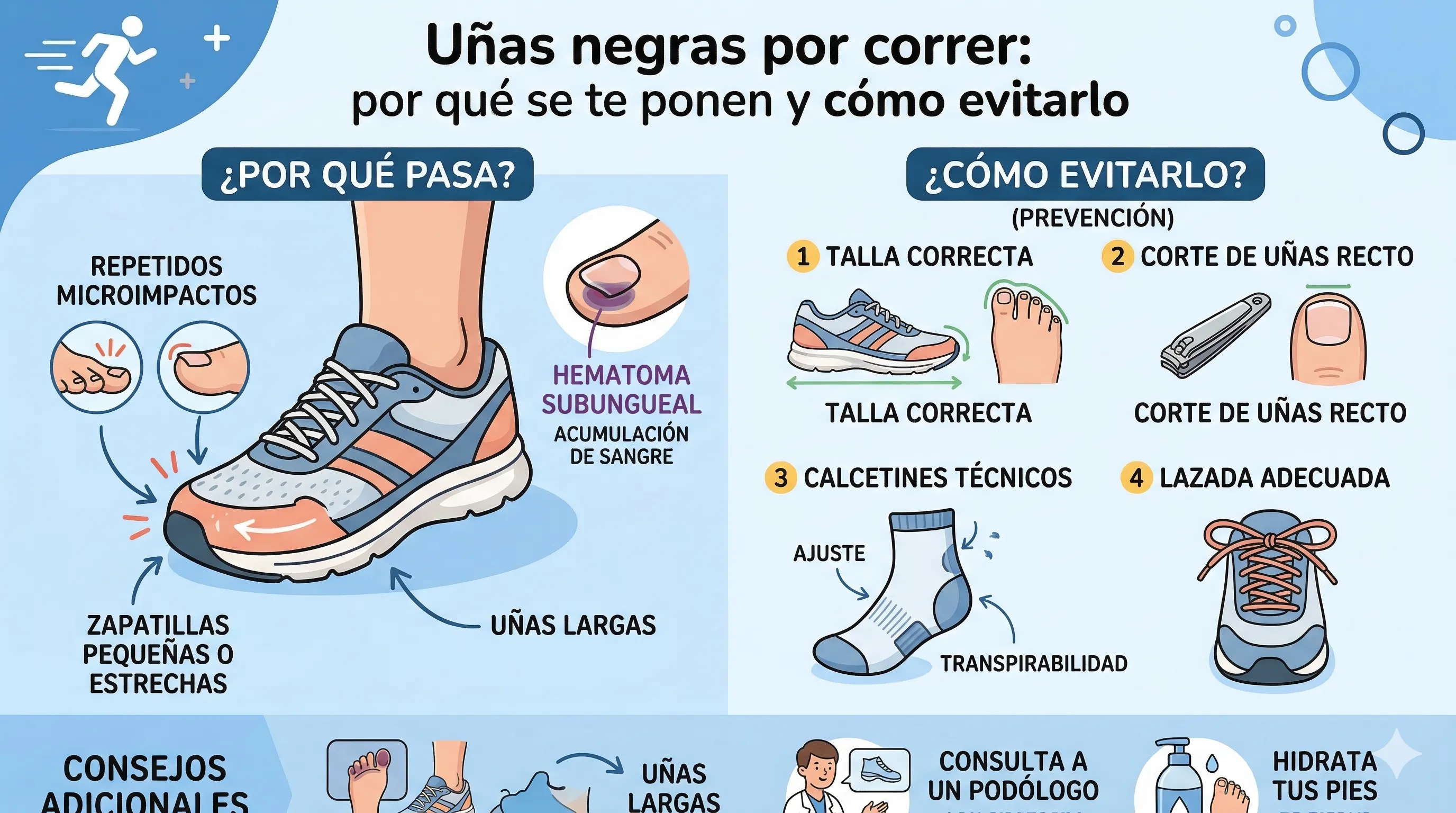
What exactly is a black toenail
A black toenail is a subungual haematoma: blood pooled beneath the nail. Every time the toe hits the shoe’s toe cap or receives repeated pressure, the tiny blood vessels in the nail bed rupture. The blood gets trapped between the nail and the skin, producing the dark colour.
It’s the same mechanism as a bruise anywhere else on the body, but under the nail the blood has nowhere to go. It stays there, pressing, and it hurts.
The 3 mechanisms that cause it
- Frontal impact: the toe slams into the toe cap on every descent. On a technical 1,000 m descent, that’s thousands of micro-impacts.
- Lateral pressure: toes compressed inside a narrow toe box. The smaller toes are especially vulnerable.
- Repeated friction: the foot slides inside the shoe, the nail rubs constantly against the sock or insole. Hours of this = haematoma.
Why it’s more common on trails than on road
On the road the stride is predictable: flat surface, steady pace, little elevation change. On trails, everything conspires against your toenails:
- Long, technical descents: every downhill step pushes the foot forward inside the shoe. On a 5 km descent losing hundreds of metres of elevation, your big toe absorbs every impact.
- Uneven terrain: roots, rocks, natural steps. The foot moves in all directions inside the shoe, not just front-to-back.
- Swollen feet: after 3-4 hours of running, feet swell. The shoe that felt just right in the morning now squeezes. And the toes pay the price.
- Moisture: a wet foot slides more inside the shoe. More sliding = more hits against the toe cap.
The number 1 cause: wrong shoe size
If you’re only going to make one change after reading this article, make it this: buy trail shoes a full size larger than your street shoe.
Not half a size. A full size. This feels counterintuitive if you come from road running, where half a size up is usually enough. But on trails, with steep descents and feet that swell over hours, you need that extra space.
How to check the size is correct
- Try them in the afternoon: feet are more swollen at the end of the day, similar to how they’ll be during a race.
- With the socks you’ll race in: not thin cotton socks.
- Thumb test: with your foot inside the shoe, standing, there should be roughly one thumb’s width of space between your longest toe and the toe cap.
- Go downhill: if you can, test them on a downhill slope. If the toes touch the toe cap, you need a bigger size.
- Wiggle your toes: you should be able to move all toes freely inside the toe box. If they’re compressed laterally, the shoe is too narrow (and that causes black toenails on the smaller toes).
Wide fit or standard?
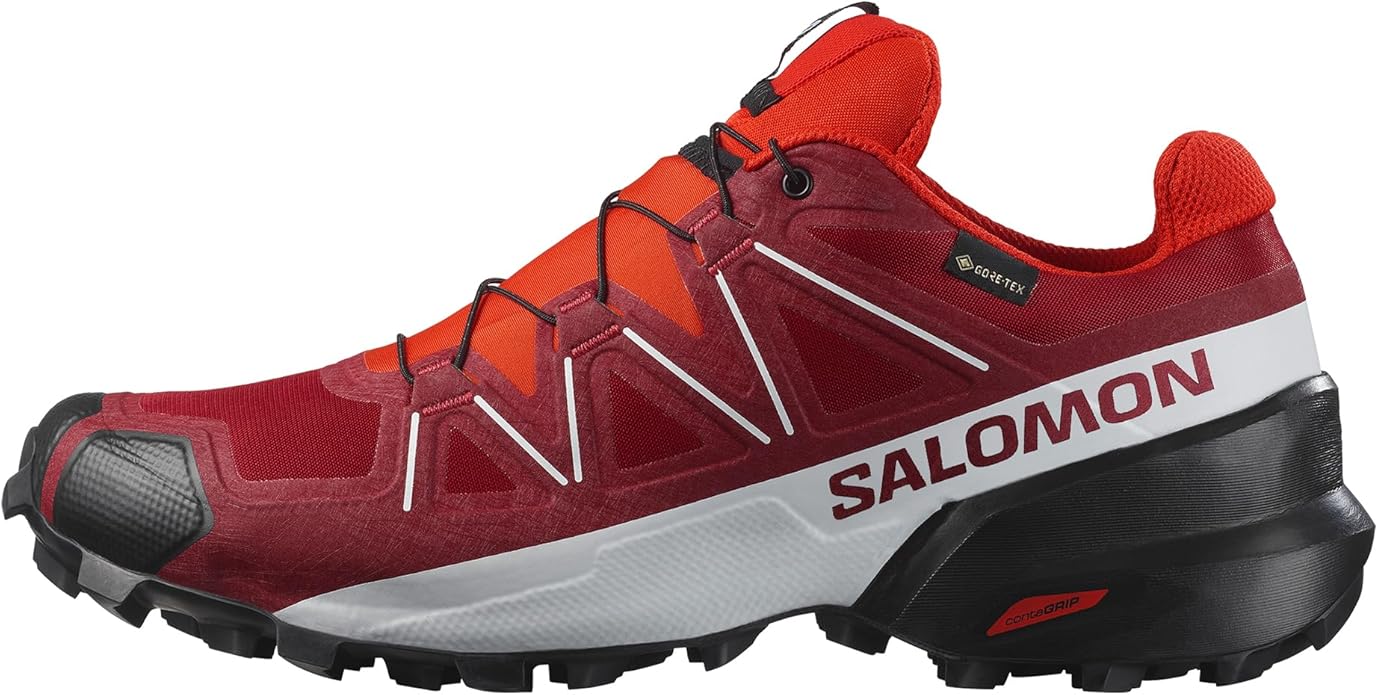
Some brands offer wide-fit versions. If you have a wide foot or splayed toes, a wide fit can be the difference between healthy nails and black ones. Brands like Altra have naturally wide toe boxes; Salomon and La Sportiva tend to run narrower.
Socks: the second line of defence
Good socks won’t compensate for the wrong shoe size, but they do reduce the problem:
Thin competition socks
For short to medium races (up to 30-40 km), thin competition socks are the best choice. Why?
- Less volume inside the shoe: more space for the toes.
- Better foot sensitivity: you notice sooner if something’s wrong.
- Faster drying: less moisture, less sliding.
A common mistake is wearing thick socks thinking they’ll “cushion” the impact. What they actually do is take up space inside the shoe, compress the toes and make the problem worse.
Toe socks
Socks with separated toes (like Injinji or OrrinSports) offer an extra benefit: they eliminate lateral pressure between toes. If your black toenails usually appear on the smaller toes, this type of sock may be the answer.


Lacing: a small detail that makes a big difference
The shoe can be the right size and still cause black toenails if the lacing doesn’t hold the foot properly. The issue is usually that the foot slides forward on descents because the heel isn’t anchored.
Heel lock lacing technique
- Thread the laces through the top eyelet to create a loop on each side.
- Cross each lace through the opposite loop.
- Pull upward (not sideways) to tighten.
- Tie as normal.
This lacing locks the heel in place. The foot stops sliding forward and the toes stop hitting the toe cap. It’s free, takes 10 seconds and works.
Mid-race adjustment
On long races, retighten the lacing at aid stations, especially before technical descents. Many runners unconsciously loosen their laces during climbs (for comfort) and forget to tighten before descending.
Trimming your nails: more important than you think
Long nails = more surface hitting the toe cap = more pressure = more haematomas. That simple.
How to trim toenails for trail running
- When: 2-3 days before the race (not the night before, because a freshly cut nail can have sharp edges that irritate).
- Shape: straight across, following the toe’s shape. Don’t round the corners — that promotes ingrown toenails.
- Length: the nail should be flush with the toe, neither longer nor shorter. Don’t cut too short, because an exposed nail bed also hurts under pressure.
- File: run a soft file along the edges to remove any snags that could catch on the sock.
Downhill technique: how to step to protect your nails
The way you descend also matters:
- Short steps: on technical descents, shorter steps mean less impact per stride. The body’s momentum pushes less against the toe cap.
- Midfoot landing: try to land on the midfoot, not the heel. When you heel-strike on a descent, the foot slides forward inside the shoe.
- Bent knees: keep the knees slightly bent to absorb impact with the muscles, not the toes.
- Don’t grip with your toes: many novice runners “grab” with their toes to brake on descents. That’s a recipe for black toenails. Let the shoe’s outsole do the gripping.
What to do if you already have a black toenail
If it doesn’t hurt much
Most black toenails don’t need treatment. The blood reabsorbs over time and the nail grows out normally. The full process can take 3-6 months (toenails grow slowly).
What you can do:
- Keep the nail clean and dry.
- Don’t pull it off. The nail, even if black, protects the nail bed. Let it fall off on its own.
- Wear roomy shoes in the days after the race to avoid further pressure.
If it hurts a lot (intense pressure)
If the black toenail hurts when walking, the pressure from the pooled blood is high. In this case:
- See a podiatrist or doctor. The treatment is to drain the blood through a small hole in the nail (trephination). It’s a quick, nearly painless procedure and the relief is immediate.
- Don’t DIY it. We’ve seen tutorials with heated paperclips and needles. The infection risk isn’t worth it.
If the nail falls off
It happens. Sometimes the black nail separates completely. It’s not the end of the world:
- Keep the nail bed protected with a plaster while it’s exposed.
- A new one will grow, though it takes 4-9 months to grow in fully.
- You can keep running, but carefully: without the nail, the toe is more sensitive. Wear well-cushioned socks and make sure the shoe has space.
When to actually worry
Black toenails from impact are annoying but benign. However, watch for warning signs:
- Intense pain that increases over the days (rather than decreasing): possible infection.
- Redness and swelling around the nail: bacterial infection.
- Pus or bad smell: infection that needs antibiotics.
- Black nail with no impact or race: if a nail darkens for no obvious reason, see a dermatologist. Subungual melanoma (a type of skin cancer) can look like a haematoma, though it’s very rare.
- Dark vertical lines on the nail: another reason to consult, especially if they appear on a single nail.
General rule: if a black toenail doesn’t improve in 2-3 weeks or gets worse, book an appointment.
Prevention plan: complete checklist
Before buying shoes
- Full size up from your street shoe
- Try them in the afternoon, with trail socks
- Thumb test: space between toe and toe cap
- Downhill test: toes don’t touch the toe cap
- Toes move freely (no lateral compression)
Before the race
- Nails trimmed straight, 2-3 days before
- Edges filed
- Heel lock lacing practised
- Shoes broken in for at least 50-80 km
During the race
- Retighten lacing before each technical descent
- Short steps on descents
- Don’t grip with your toes
- At aid stations: retighten laces
5 rules to stop losing toenails
- Correct size. A full size up from your street shoe. No exceptions.
- Heel lock lacing. The heel doesn’t move, the toes don’t hit the toe cap.
- Short nails. Trimmed straight, 2-3 days before racing.
- Thin socks. More room for the toes, less sliding.
- Downhill technique. Short steps, bent knees, let the outsole do the work.
Black toenails aren’t a rite of passage or a badge of honour. They’re a mechanical problem with a mechanical solution. Adjust your footwear, look after your feet and save the suffering for the climbs.
If you’re looking for your next trail race, every race on TrailRunTemple includes a Pack 360 with all the gear you need, shoes and socks included. And if blisters are also giving you trouble, don’t miss our guide on blisters in trail running.