Allergies and pollen in trail running: how to run in spring without suffering
Allergies and pollen: the invisible enemy of the spring trail runner
March arrives, temperatures climb, the days grow longer and the mountains fill with colour. It’s the perfect time to run in the hills. Except for one thing: pollen.
If you’re allergic (and over 30% of the population in Spain is), spring turns every trail outing into a gamble. Watering eyes, runny nose, itchy throat, coughing that won’t let you breathe. Add the demands of trail running — deep breathing, open mouth, hours exposed to the outdoors — and you have the perfect recipe for misery.
But being allergic doesn’t mean giving up running in spring. It means running with strategy. This guide covers everything you need to know to minimise symptoms and enjoy the trail even at the peak of pollen season.
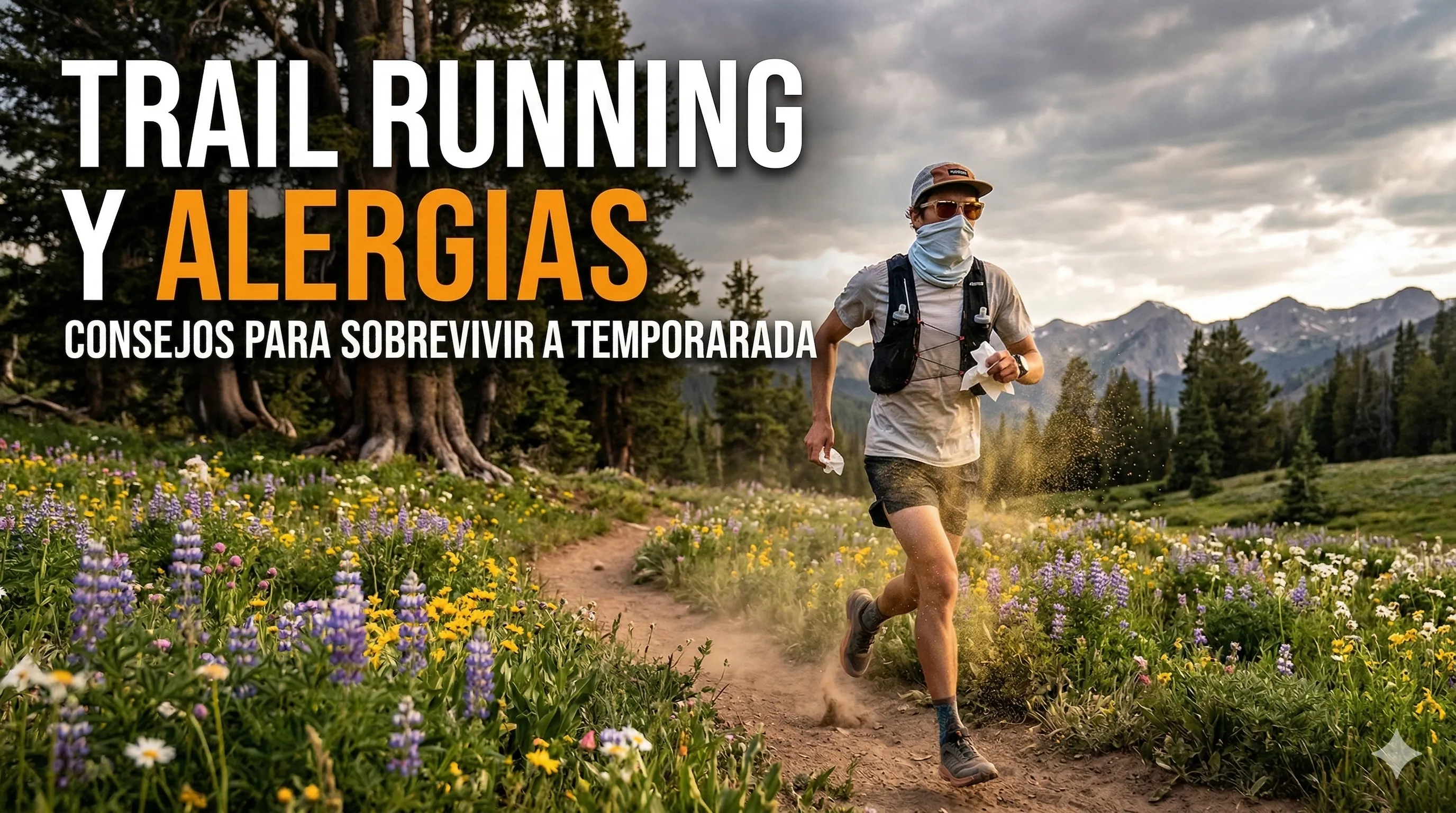
What happens to your body when you run with allergies
When you breathe in pollen, your immune system identifies it as a threat and releases histamine. That causes inflammation in the airways, mucus production and itching. So far, the same as sitting on a terrace.
But when you run, three things change:
- You breathe a greater volume of air: at rest you inhale about 6-8 litres of air per minute. Running uphill, between 60 and 100 litres. You’re inhaling 10 to 15 times more pollen.
- You breathe through your mouth: the nose filters out some pollen. When intensity rises and you open your mouth, pollen goes straight to your bronchi and lungs.
- Intense exercise can amplify the allergic response: some studies show that physical exertion increases histamine release, worsening symptoms.
The symptoms that most affect performance
- Nasal congestion: forces mouth breathing, which dries the throat and reduces respiratory efficiency.
- Tearing and itchy eyes: blurred vision on technical descents is a safety issue, not just a comfort one.
- Coughing and chest tightness: in allergy sufferers with an asthmatic component, exercise-induced bronchospasm can be serious.
- General fatigue: the allergic response uses energy. You’re not weak — your body is fighting on two fronts.
When pollen peaks (and when to avoid it)
Not all spring days are equal. Pollen concentration varies enormously depending on the time of day, weather and location.
Daily pollen peaks
- Maximum: between 5:00 and 10:00 in the morning (emission) and between 19:00 and 22:00 (when pollen descends as the air cools).
- Minimum: early afternoon (14:00-17:00), when pollen is in higher atmospheric layers.
Strategy: if you have schedule flexibility, train at midday or early afternoon. It’s counterintuitive (more heat), but there’s less pollen at ground level.
Weather and pollen
| Condition | Pollen level | What to do |
|---|---|---|
| Dry, windy day | Very high | Avoid or go out with maximum protection |
| After rain (2+ hours) | Low | Ideal time to run |
| Cloudy day, no wind | Medium-low | Good training window |
| Thunderstorm | Dangerous | ”Thunderstorm asthma” breaks pollen grains into smaller particles that penetrate deeper |
Altitude: your ally
Good news for trail runners: the higher you go, the less pollen. Grasses and olive trees (the main allergens in Spain) concentrate their pollen below 1,000-1,200 metres. If you have access to high-mountain trails, spring is your best time to use them.
Anti-pollen gear for trail running
You don’t need a hazmat suit. Three pieces of gear will drastically reduce your exposure.
1. Trail sunglasses with lateral protection
Sports sunglasses serve double duty: they protect from the sun and create a physical barrier against pollen. The best ones for allergy sufferers have lateral protection (wrap-around design) that blocks particles from entering at the sides.
Look for models with:
- Photochromic lenses (adapt to light, useful in forest and open terrain)
- Controlled ventilation (no fogging, but not letting pollen pour in)
- Close fit that leaves no gaps between the lens and your face

2. Buff or neck gaiter over nose and mouth
A tubular neck gaiter pulled up over the nose acts as a mechanical filter against pollen. It’s not a medical mask, but it retains a significant portion of larger particles (like grass pollen).
Key: choose a thin, breathable fabric. If you use a winter thermal buff, you’ll suffocate. Summer models with UV protection and cooling technology are the best option.

Tip: wear the buff damp. A slightly wet fabric traps more particles. You can wet it at every fountain or stream along the way.
3. Cap or visor
Not just for the sun. A cap prevents pollen from settling on your hair and falling towards your eyes and face. After running, shake the cap before taking it off to avoid launching a pollen cloud into your face.

Training strategies for allergy sufferers
Check pollen levels before heading out
Just as you check the rain forecast, check the pollen forecast. Free resources:
- polenes.com (Spanish Aerobiology Network): levels by station and pollen type.
- AEMET (national weather service): forecasts include pollen warnings in spring.
- Allergy apps: Pollen, Klara, AlertaPolen. Notifications when levels rise.
Adapt the type of workout
On high-pollen days, it’s not the time for your maximum-effort interval session. The more intense the breathing, the more pollen enters.
- High pollen: easy run, light jog, technique work. Or an indoor session (treadmill, elliptical, strength).
- Medium pollen: moderate training with buff, sunglasses and nose monitored.
- Low pollen: train normally. Make the most of the windows.
Choose the right terrain
- Avoid: grass fields (open meadows), olive groves, pine areas if you’re allergic to them.
- Seek out: deciduous forests (beech, oak — produce less allergenic pollen), coastal trails (sea breeze pushes pollen inland), high mountains (+1,200 m).
- Watch out for: recently cleared forest tracks. Clearing stirs up dust and plant debris that irritate the airways.
Coming home: the anti-pollen routine
What you do after running is as important as what you do during:
- Strip off at the door: don’t walk pollen-covered clothes through the house.
- Shower immediately: hair, face, nostrils. Pollen accumulates in hair and keeps triggering symptoms hours later.
- Nasal rinse with saline solution: clears remaining pollen from the nasal passages. Sounds uncomfortable, works.
- Wash training clothes: don’t leave them for “another day”. Pollen builds up and resuspends every time you move the clothes.
- Don’t dry clothes outdoors: clothes hung on the balcony in spring are a pollen collector.
Medication and trail running: what you need to know
Important: this doesn’t replace a consultation with your allergist. Every allergy is different and medication should be supervised by a professional.
Antihistamines
Second-generation antihistamines (cetirizine, loratadine, bilastine) are the most widely used. Unlike first-generation ones, they don’t cause drowsiness (or much less), which is critical if you’re running in the mountains.
- When to take them: preventively, before heading out. Most take 30-60 minutes to take effect. If you wait until symptoms appear, you’re too late.
- Competition note: antihistamines are NOT on the WADA prohibited substances list. You can race with them without any issue.
Antihistamine eye drops
For itchy eyes, an antihistamine eye drop (olopatadine, ketotifen) applied before heading out can make a real difference. Especially useful if sunglasses aren’t enough of a barrier.
Inhalers
If you have allergic asthma or exercise-induced bronchospasm, always carry your rescue inhaler (salbutamol) in your pack. Always. Not “I probably won’t need it”. Always.
- If you use a preventive inhaler (inhaled corticosteroid), use it according to your doctor’s schedule, not only when symptoms appear.
- In competition: inhaled salbutamol is permitted by WADA without a Therapeutic Use Exemption (TUE) up to certain doses. Check the latest rules if you compete at a federated level.
Immunotherapy (allergy shots)
If your allergy is severe and limits you every spring, talk to your allergist about immunotherapy. It’s a 3-5 year treatment that reduces sensitivity to the allergen. It’s not an immediate fix, but many allergic runners report a dramatic improvement that lets them train normally.
Action plan: your checklist for running in spring
Before the season (February)
- Visit your allergist: review medication, update treatment if needed.
- Get trail sunglasses with lateral protection.
- Buy a lightweight, breathable buff to cover nose and mouth.
- Install a pollen level app.
Before each outing
- Check pollen levels and hourly forecast.
- Take antihistamine 30-60 min before (if your doctor recommends it).
- Apply eye drops if needed.
- Gear up: sunglasses + buff + cap.
- Check you have your inhaler if you use one.
During the run
- Buff over nose in open areas with vegetation.
- Breathe through the nose whenever intensity allows.
- If symptoms worsen, lower the intensity or shorten the route.
- Wet your buff at fountains or streams to improve filtration.
Afterwards
- Clothes off at the door.
- Immediate shower: hair, face, nose.
- Nasal rinse with saline solution.
- Wash clothes, don’t dry outdoors.
Pollen types in Spain: know your enemy
Not all pollen is equal, and it doesn’t all appear at the same time. Knowing what affects you lets you anticipate the worst moments:
| Type | Peak months | Most affected area | Altitude |
|---|---|---|---|
| Cupressaceae (cypress) | January-March | All of Spain, especially cities | Low-medium |
| London plane tree | March-April | Cities (parks, avenues) | Low |
| Grasses | April-July | Central and northern Spain | Low-medium (under 1,000 m) |
| Olive | May-June | Andalusia, Castilla-La Mancha, Extremadura | Low-medium (under 800 m) |
| Parietaria | March-October | Mediterranean coast | Low |
Key fact: if you’re allergic to grasses (the most common allergen in Spain), your worst months will be April-June, but above 1,200 metres the concentration drops drastically. That mountain race you’re eyeing nervously could be friendlier than a training run in your city park.
Beginner mistakes that worsen allergies
- “It’ll clear up once I start running”: no. Intense exercise worsens symptoms. If you start badly, it’s only going downhill.
- Running first thing in the morning: that’s peak pollen emission time. Better at midday.
- Training without sunglasses: the eyes are the most irritating entry point. Wrap-around glasses make a dramatic difference.
- Not taking preventive medication: antihistamines work better before exposure, not after you’ve sneezed 40 times.
- Ignoring the wind: a sunny, windy day is the worst combination. That’s a gym day.
- Stuffing pollen-covered running clothes into a closed car: congratulations, your car is now a pollen chamber.
Summary: 5 keys to trail running with allergies
- Check pollen levels before every outing. Running blind means suffering needlessly.
- Protect your eyes and nose. Wrap-around sunglasses + lightweight buff over the nose. Two items, big difference.
- Choose your time and terrain. Midday > morning. Altitude > valley. Post-rain > windy day.
- Preventive medication. Antihistamine before heading out, eye drops if needed, inhaler always in the pack if you’re asthmatic.
- Post-run routine. Immediate shower, nasal rinse, clean clothes. Pollen doesn’t stop when you stop running.
Pollen allergy is an inconvenience, not a sentence. With the right tools and strategy, spring can still be your favourite season for running in the mountains. You just need to run smarter than the pollen.
If you’re planning your spring season, check out our trail race finder to find races in high-mountain areas where pollen is lower. And to gear up with everything you need, every race on TrailRunTemple includes a complete Pack 360.